From AI Hype to Defensible Screening Practices
The AI conversation in hiring has largely focused on efficiency. Faster workflows. Smarter filtering. Reduced administrative burden. But the real shift isn’t about speed. It’s about adversarial sophistication. AI hasn’t just changed how organizations hire. It’s changed how fraud operates.
If you would like to explore the full webinar (AI Disruption in Background Screening - What HR Leaders Must Get Right on February 26, 2026) that inspired this blog post, please watch below.
AI Didn’t Just Accelerate Hiring - It Professionalized Deception
Fraud used to be clumsy. Resumes had inconsistencies. Interviews revealed skill gaps. Fake credentials were easier to detect. Today, AI-generated resumes can be tailored precisely to job descriptions. Interview coaching tools can feed real-time responses. Deep fake technology can simulate convincing identities. Assessment tools can be trained to score “well enough” to avoid suspicion. Fraud is no longer reactive. It’s engineered. That changes the defensive posture required from HR leaders.
Compliance Alone Is No Longer Enough
Historically, background screening programs were designed around:
- Regulatory compliance
- Document verification
- Turnaround time
- Operational efficiency
But AI-enabled deception exposes a structural weakness. A process can be compliant, and still be vulnerable. Defensibility now requires resilience, not just adherence. It requires thinking beyond “Did we follow the rules?” to “Would this hold up under scrutiny"? That’s a higher bar.
From Steps to Systems
In a recent webinar with Anton Watson of Background Check Advisory and Will Sloat of Checkmate, one theme was clear: organizations must think in systems, not steps. Defensible screening depends on alignment across four interconnected pillars:
Product: Are the checks you’re running actually mitigating modern risks?
Policy: Are your standards written for today’s threat landscape?
Process: Are controls mapped to real vulnerabilities?
Provider: Is your screening partner evolving with emerging fraud tactics?
If one pillar lags, the entire structure weakens. This isn’t about adding another check to the workflow. It’s about redesigning the architecture.
Fraud Is Moving Earlier in the Funnel
AI-enabled fraud doesn’t begin at the background check stage anymore. It begins at resume submission. At assessments. At interviews. At identity verification. That shift matters. Identity validation can’t be an afterthought. Documentation review can’t rely solely on manual inspection. Human intuition alone is no longer sufficient to detect synthetic behaviour. AI hype focuses on capability. Defensibility focuses on control.
Use Good AI to Combat Bad AI
The solution is not to retreat from AI. It’s to deploy it intelligently. AI can now:
- Flag likely AI-generated resume patterns
- Detect subtle deep fake artifacts
- Identify documentation inconsistencies
- Cross-reference structured digital data sources
But technology must operate within a governed system. Otherwise, you’re simply automating blind spots. AI is a tool. Governance is the safeguard.
Defensibility Means Explainability
In an AI-adversarial environment, the most important question becomes: If challenged, can you explain your decisions? Why this candidate passed. Why this one didn’t. What controls were applied. Where human oversight intervened. Efficiency may impress stakeholders. Explainability protects the organization. As automation increases, the burden of clarity increases with it.
Moving Beyond the Hype
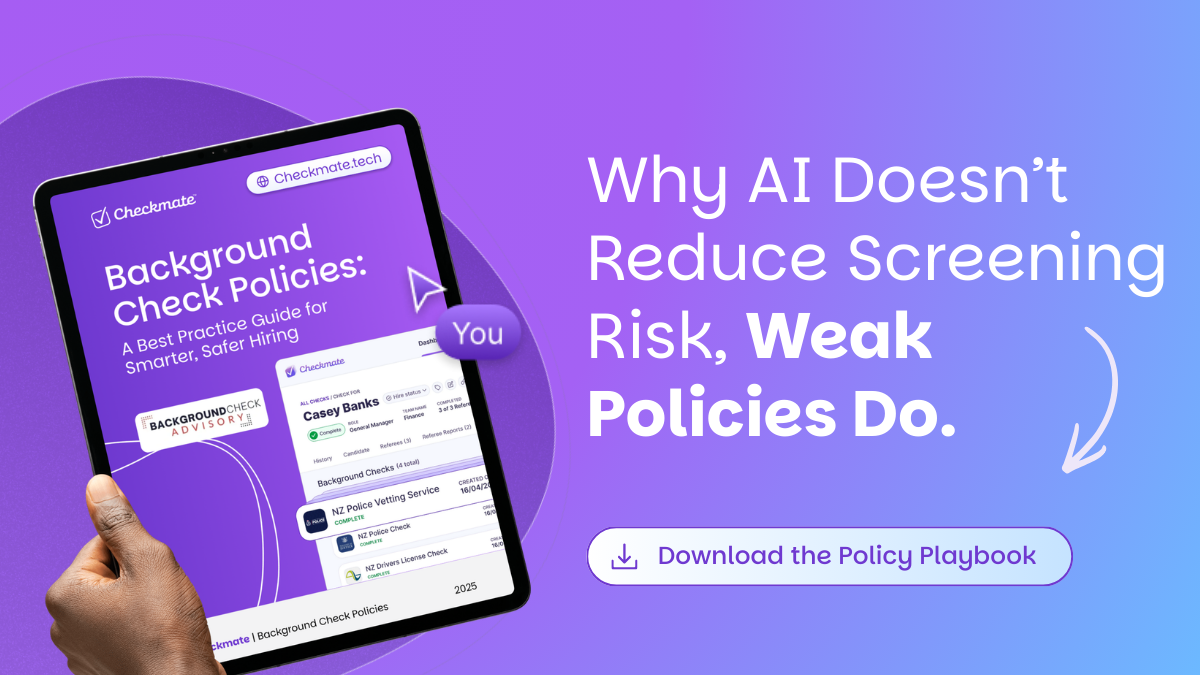
AI hype centres on possibility. Defensible screening centers on accountability. The organizations that will navigate this shift successfully won’t be those who adopt AI fastest. They’ll be those who design screening systems deliberately, aligning policy, process, product, and provider to withstand scrutiny. If you’d like to explore the full conversation that inspired this piece, the webinar recording is embedded above. And if you’re reassessing your screening standards, the Background Check Policy Playbook offers a practical framework for strengthening them before scaling further. Because hype fades. But defensibility endures.
Strengthen Your Screening Foundation Before Scaling Further