
AI Readiness Isn't a Training Problem. It's a Sequencing Problem.

Insights from a senior HR roundtable: building an AI-ready workforce is about sequence. Define the work, assess capability, then close the gaps.
I recently hosted a small, invite-only roundtable for senior HR leaders at technology and professional services companies, alongside Dr. Adena White of HiBob. The topic was building an AI-ready workforce. The conversation was candid, and it kept circling the same problem. Leadership wants the organization to be "AI-ready". Almost no one can say what that means. So the default move is to buy a course, run a lunch-and-learn, and hope it sticks. I don't think AI readiness is a training problem. It's a sequencing problem. Most organizations are trying to close a gap they haven't defined or measured.
The Expectation Is Already Here
HiBob's research surveyed 1,200 AI decision-makers. 75% of them expect moderate AI proficiency to become standard across most non-technical roles within the next 24 months. And 67% already link AI skills to promotion criteria, while 50% tie them to performance ratings. Read that again. Organizations are rewarding and grading AI skills before agreeing on what good looks like. That's not a talent problem. That's a standards problem. We're marking people on a test nobody has written yet.
Step 1: Define. Start With the Work, Not the Job Title
"Be more AI-ready" is not an instruction. It's a mood. Defining AI-ready is management and HR work before it's employee development work. It starts with the responsibilities and workflows that make up the job, not the title on the org chart. A few questions to answer first:
- Which one or two workflows most need a clear definition of "AI-ready" right now?
- What outcome are you trying to improve: quality, speed, cost, risk, or customer experience?
- Where does human judgment, review, or accountability stay non-negotiable?
- Who needs to help define this: HR, functional leaders, IT, legal, managers?
If you can't answer those, no training program will land. HiBob's AI Skills Framework is one useful starting point for building a shared language around AI capabilities by role.
Step 2: Assess. Measure Behaviour, Not Enthusiasm
Once you’ve defined what good looks like, you need to see it. Most assessment starts and stops with “Do you use AI?” and “How confident are you?” Those questions measure access and self-belief. They tell you very little about capability. The better question is how people use AI in real work. Can they decide when it’s appropriate? Provide useful inputs? Verify outputs? Handle sensitive information? Improve the workflow over time?
HiBob’s data points to the same thing. 52% of respondents rank proactively reviewing output quality as one of the most critical everyday AI behaviours. That’s judgment, not coding.
There’s also a gap between what leaders say and what they can see. 77% of HR and business leaders say they have a clear, shared definition of strong AI skills. Only 24% use tools like skills catalogues or ATS tagging to identify the people who have those skills.
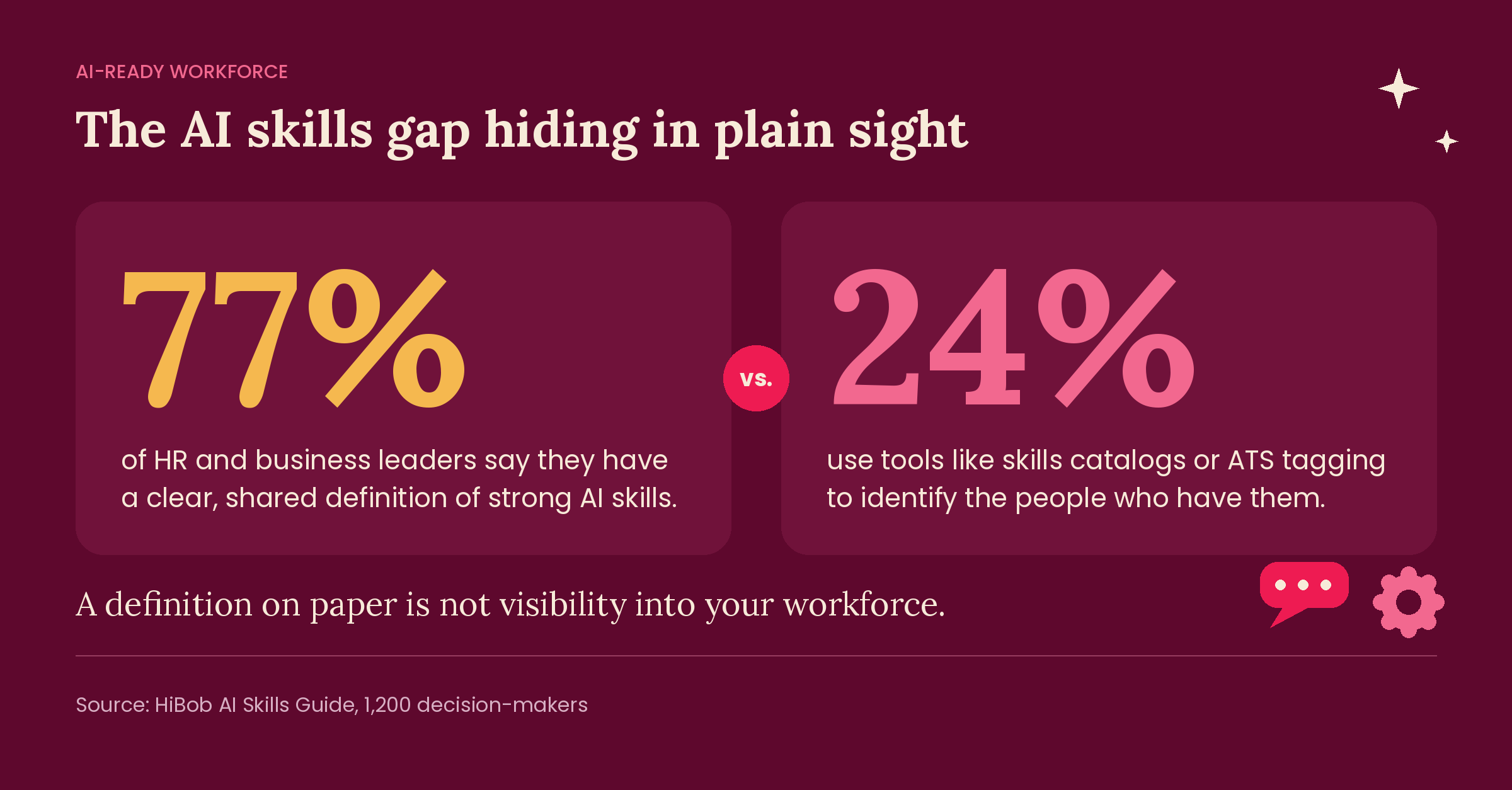
A definition on paper is not visibility into your workforce. Individual evidence needs to roll up into a team-level view of strengths, gaps, and priorities. And you need to separate a learning need from a workflow, tooling, or policy problem. Otherwise you’ll train people to fix something training can’t fix.
Step 3: Close. Build an Operating Model, Not a Course
Here's where most organizations stop at a one-off program or an annual skills audit. Closing the gap is an ongoing cycle: learning in the context of real work, manager coaching, protected time to practice, clear standards, feedback, and reassessment as tools and workflows change. The data shows how thin the current effort is. Fewer than a third of organizations use even the most common supports, like funded learning (30%) and protected practice time (29%). And among respondents who expect managers to lead AI capability building, only 36% see those managers as highly prepared.
Managers are expected to carry this. Most haven't been equipped to. Without conditions that support improvement, AI capability becomes one more unsupported expectation on employees.
Why the Order Matters
Skip step one, and your training is generic. Skip step two, and you can't tell a skills gap from a tooling problem. Skip step three, and you've done a great assessment that changes nothing. These aren't three separate challenges. They're a sequence. Where an organization gets stuck tells you what to fix next.
What You Can Do This Month
You don't need a transformation program to start. You need three decisions:
- Define: Pick one or two priority workflows and write down what "AI-ready" looks like in each, including where human judgment stays essential.
- Assess: Choose three observable behaviours that would show someone is using AI well, and decide how you'll see them at team level.
- Close: Pick your first lever (training, manager enablement, work redesign, hiring, or tooling), name an owner, and set a date to reassess.
A Final Thought
I keep coming back to how often "AI-ready" is used as a slogan. It shouldn't be. It should be a decision about the work, a way of seeing capability, and a system that helps people improve. Define the work. See the capability. Build the conditions. In that order.
If you'd like to be part of the next small, invite-only roundtable on this topic, message me directly and I'll add you to the list.
Disclosure: HiBob has been a long-time client and partner of mine, and I only work with HR tech companies I’d buy myself as an HR leader. The research cited above is HiBob’s own.